
"Could you just...?"
Small words with a big impact

A client told me recently about a phrase her boss uses constantly: “Could you just…?”
For her, those three words trigger an immediate reaction – an inner eye roll, a knot in her stomach. Because she knows what follows won’t be “just” anything. It will be a big piece of work, disguised as something small. And because it’s her boss, she can’t always simply say no.
That tiny word – just – is doing a lot of heavy lifting. It’s making the request sound lighter than it really is. It’s softening the imposition, but at the expense of honesty. And this isn’t an isolated quirk; there are plenty of little words and phrases that we slip into our language – often without thinking – that distort meaning or undermine trust.
In today’s Substack, we’re going to explore four that show up again and again in conversations at work, and whose effects can spread far beyond one simple interaction.

Disguising or minimising asks
The most common culprit is just. But it has a few familiar friends: quick, easy, little.
“Can you just pull together a few quick slides?”
“It’s a little update.”
“It should be easy enough.”
What the other person hears is: This is a big chunk of work, and I’m going to pretend otherwise.
The result? Resentment. Because the request feels disingenuous. A better approach is to acknowledge the real size of the task, rather than shrinking it with filler words that everyone sees through.
False collectives
Then there’s the “we” problem.
“We need to fix this by tomorrow.”
“Let’s update the data.”
On the surface it sounds collaborative, but more often than not what it really means is you. Leaders use “we” as a way of softening instructions, but in practice it muddies accountability. The person on the receiving end is left wondering: Is this genuinely a joint task, or have I just been handed the whole thing?
Or worse, are you just saying we to make you look better, but this is very shortly going to be dumped on me with little or no help or contribution from you.
Being clear – “I need you to do this by Friday” – is kinder than pretending it’s a shared responsibility.
Passive shields
Another tactic I’ve seen far too many times is to use vague, distancing language:
“It’s been decided that…” (by whom? In my head this is usually said in a deeply sarcastic tone…)
“It seems that…”
“It looks like we should…”
These are like verbal shields: they avoid ownership and soften responsibility. But the unintended effect is erosion of credibility. People begin to wonder: Is this person actually making the call, or are they afraid to stand behind it?
Strong leadership requires owning our decisions. Sometimes that means being direct: “I’ve decided we’ll go this way.” It can feel riskier in the moment, but it builds trust in the long run.
Inflating for status
And finally, the words that are frankly irritating – the inflation words. Alongside what tends to run through my head when I hear them…
• “This is a strategic task.” (Errrm….really?)
• “It’s critical we…” (Is it though? Critical?)
• “This piece of work will make a real difference.” (Right. Not sure that’s actually true.)
Don’t get me wrong, there are clearly things we do which are strategic, critical, and which make a real difference. But these words are overused.
Language like this is often used to dress up work that is routine or menial, to make it sound grander than it is, but it fools no one. Instead of motivating, it breeds cynicism. And when everything is described as “critical” or “strategic”, those words lose their meaning.
A more honest approach is both more motivating and more respectful: “This is unglamorous work, but it is important, and I’d value your help with it.”
So what can you do?
It’s one thing to notice these loaded words. It’s another to know how to handle them in practice – particularly if the person using them is your boss.
If you’re on the receiving end
It can feel uncomfortable – even risky – to push back when someone in authority minimises a request. The key isn’t to argue, but to bring clarity. Try asking:
“Roughly how much time do you expect this to take?”
“I’m happy to take this on – which of my current priorities should I pause to make space for it?”
“Can we sit down and talk this through, so I’m clear what you expect, and which parts you will take on?”
These questions surface the hidden cost without confrontation. They give your boss a chance to acknowledge the reality of what they’ve asked.
If you’re a bystander/observer
When you hear peers doing this to others, you have a role too. It might be as simple as reframing in the moment – “That sounds like quite a chunk of work, let’s make sure it gets factored in properly.” These small interventions can prevent a culture of minimising from taking hold.
If you’re a leader
Try to be alert to these words in your own vocabulary and in your team’s. What feels like a harmless phrase – “Could you just…” – can steadily corrode morale. People start to feel their work is undervalued or misrepresented.
Catch yourself when you reach for these shortcuts, and if you realise you’ve been disingenuous, revisit the conversation and own that out loud. If you hear your managers using them, call it out early. Naming the habit is the first step to breaking it.
These strategies won’t eliminate the language overnight, but they start to shift the dynamic. They show respect for the real effort involved, and they set a tone where clarity and honesty take precedence over convenience and performative behaviour.
And that’s what makes the difference. Because these aren’t filler words, they’re signals – about how we value people, how we share responsibility, and how we lead.
It’s small stuff. And it has a big impact.
Which words do you catch yourself using? What might they reveal about how you want to be seen or how you want others to respond? Hit reply or leave a comment and let me know.
Small is the New Big
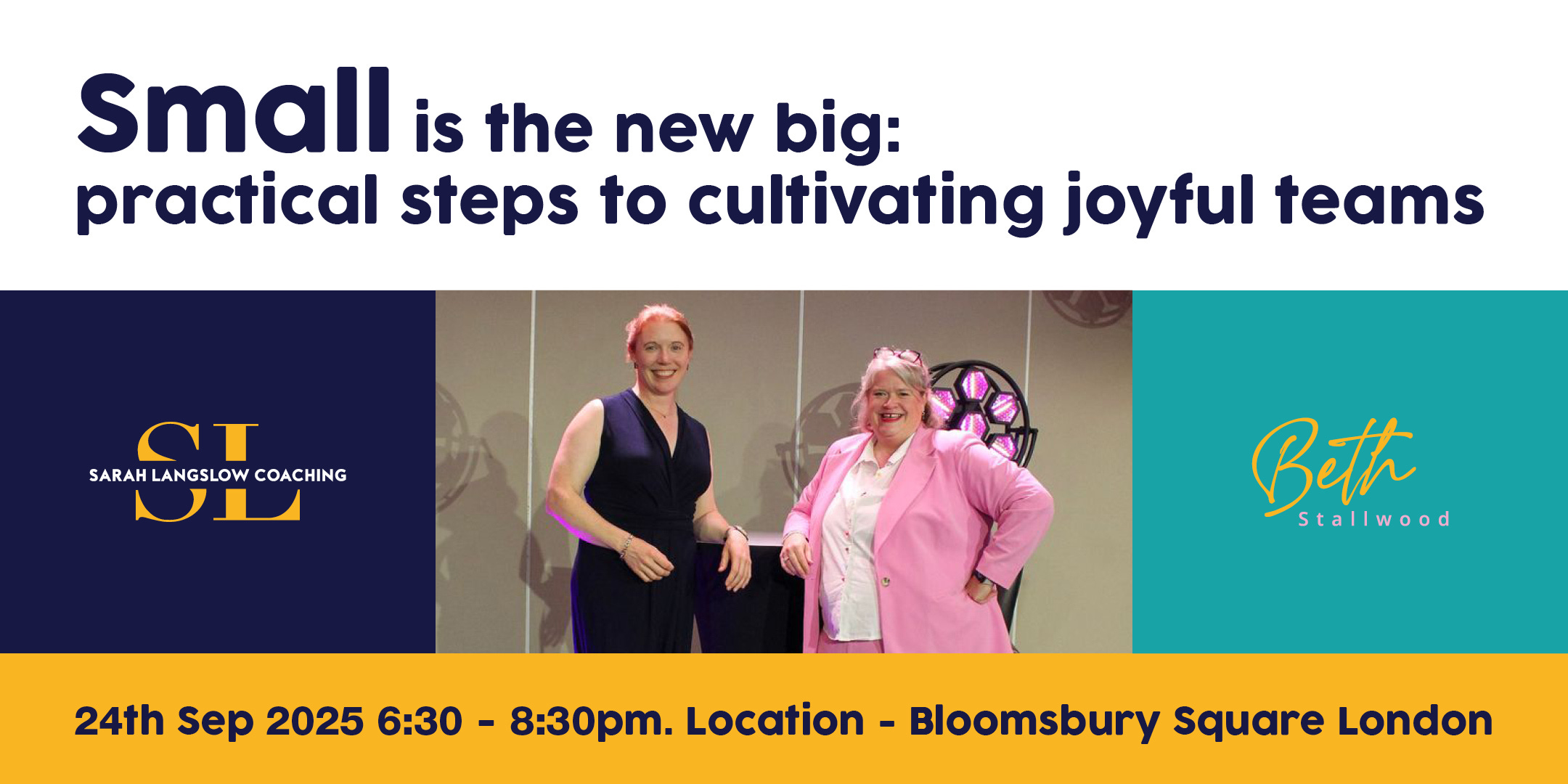
September is coming in hot….
If you’re already slightly dreading the return to chaos in September, join me and the fabulous Beth Stallwood for a zero-waffle, uplifting evening on using micro-behaviours to shape joyful, effective teams.
Small is the New Big will be a practical, fun event where you’ll leave with ready-to-use scripts, habits, and a simple plan for tackling overwhelm and building a healthy working culture – all through tiny, manageable interventions.
There will also be fizz, nibbles, and good humans to mingle with.
Wednesday 24 September, 6:30pm, Pushkin House (Bloomsbury, London).
Tickets are just £25; and you can add (discounted) signed copies of Do Sweat the Small Stuff and/or WorkJoy at checkout. Book your spot via this link.
Restack
“The language you clothe your mind with determines your life experience.” This is a lovely exploration of the magic power of words…enjoy.

Meme of the week
This one is part parenting tip, part a beautiful illustration of the power of words… 😂

Want to read more from me? Read my book, Do Sweat the Small Stuff, or read my full Substack archive here.
Please use this button to share this with someone who you think would enjoy it!
Get in touch by email if you’d like to explore me speaking to your organisation or at your event, or are interested in working with me as a coach. Follow me on Linkedin for more regular content.
Thanks for reading. See you next week!