

A client of mine, let’s call her Jo, was three months into a restructure, working through new reporting lines and new team boundaries. She was providing regular updates, led a Q&A session and was happy to answer questions from her team on an ad hoc basis; nobody was being kept in the dark.
Then one of her directors found out, via an innocuous comment from someone else, that a meeting about the restructure had happened without them. They weren’t upset about the change itself, they were upset about being left out of the meeting, despite it being one of a dozen that week that they had no need or particular reason to be at. However from their perspective, the omission felt like something else entirely.
It’s a dilemma most leaders leading change will recognise. Explain the reasoning behind every tiny decision (including who is invited to which meetings), or invite everyone to everything, and you’ll never get anything done. Don’t, and someone eventually feels snubbed, even when there’s no meaning or malice in it.
That’s the catch 22. Say too much and people think you’re over-explaining or over-managing people. Say too little and people fill the blanks themselves, not always in a good way. If it feels like you’re wrong whichever way you go, that’s not a sign you’re doing it badly, it’s the nature of the beast. Let’s explore.

Get used to being wrong either way
Over- and under-explaining can both feel like reasonable choices in the moment. This isn’t about being careless vs. careful. Often it comes down to something much simpler: your own comfort with uncertainty. If you hate not knowing, you’ll probably default to giving others the full picture to try to reassure them. If you’re more relaxed about ambiguity, with a kind of “I don’t need to know, I’m sure it’s fine” attitude, you’ll probably under-explain, because you genuinely wouldn’t need more detail yourself.
Neither instinct is wrong, however, neither is automatically right for the person in front of you. Part of managing this is noticing your own default and being aware that your team won’t all share it – some will want more than you’d naturally offer, some less. What matters is knowing your own preference, so you can catch yourself when you’re defaulting rather than choosing.
It is one of many leadership challenges with no right answer – the appropriate level of transparency depends on context, history, the individual, and the trust already built between you. Then it’s about noticing your impact. If something feels off, do something about it – adjust, experiment, have the conversation – rather than live with the discomfort or just dismiss it and move on.
You’re always training people what to expect
Whichever way you lean by default, you’re teaching people something about what’s normal, usually without meaning to. This is what I mean when I say “we are always training people how to treat us” – our patterns become familiar, and the people around us adjust their expectations and behaviour to match.
Over-explain consistently, and silence reads as trouble. Under-explain consistently, and people fill the gaps themselves based on their fears and insecurities. Either way, the pattern you default to becomes the norm, and it’s changes from that norm that cause friction later, not the original choice itself. Jo’s director wasn’t reacting to one missed meeting invitation. They were reacting to a gap between what they’d come to expect and what happened this time.
This is usually both unintentional and entirely self-created. Nobody sets out to build this dynamic; it develops the background through repetition, until one day a conversation, or a question, or a meeting invite lands in a way you don’t intend.
Relationship does what explanation can’t
The good news is that the search for “the right amount to explain” is the wrong question; what makes a difference is the underlying relationship. It’s about building enough trust that someone can tolerate not knowing. Enough trust that they’ll ask you directly if they’re genuinely worried, rather than assume the worst. Enough trust that you can sometimes say “not right now” without it landing badly.
Relationship also allows you to have a different conversation when someone’s anxious about something you haven’t explained. Instead of supplying more information, try addressing the how and why of their need to understand; ask what’s making them uneasy, rather than justifying the decision itself. Often that’s the real issue.
It’s one more place where consistency over time is key. Trust isn’t about explaining, it’s built through being consistent between what you say and what you do. The stronger that foundation, the less weight any individual instance of silence or explanation carries.
Notice, then choose
If you’re facing this challenge yourself with a particular team member, here are a few practical suggestions to try:
Notice your own default. Do you tend to over- or under-explain, and which is your instinct under pressure, when you’re busy and operating on autopilot?
When you choose not to explain something, say so explicitly rather than leaving it ambiguous. “I’m not going to unpack this fully right now, and that’s not because anything’s wrong” does more work than silence.
When someone’s anxious about something you haven’t explained, ask what’s driving the worry before you answer the surface question. Sometimes the real issue isn’t the decision itself.
Build the trust account before you need to draw on it. Regular, honest one-to-ones do more for that than any single well-worded explanation in the moment.
And let go of getting this exactly right. There is no correct line between transparency and trust – it’s about noticing when you’ve drifted too far either way and then course-correcting.
Stop looking for the “right” way
Most leaders will get this wrong in both directions at different points, potentially even with the same person. Jo wasn’t wrong to run a working session without her director in the room. She also wasn’t wrong to have built a culture of openness that made the gap feel jarring when it appeared.
The goal is to build enough trust, and enough self-awareness, that getting it wrong occasionally doesn’t do any lasting damage.
Hit reply or leave a comment to tell me: do you tend to over-explain or under-explain, and what has it cost you when it went the other way?
Restack
This week an interesting one from Simon Sinek on what happens when an established narrative we have about someone (or something) is challenged by new information.

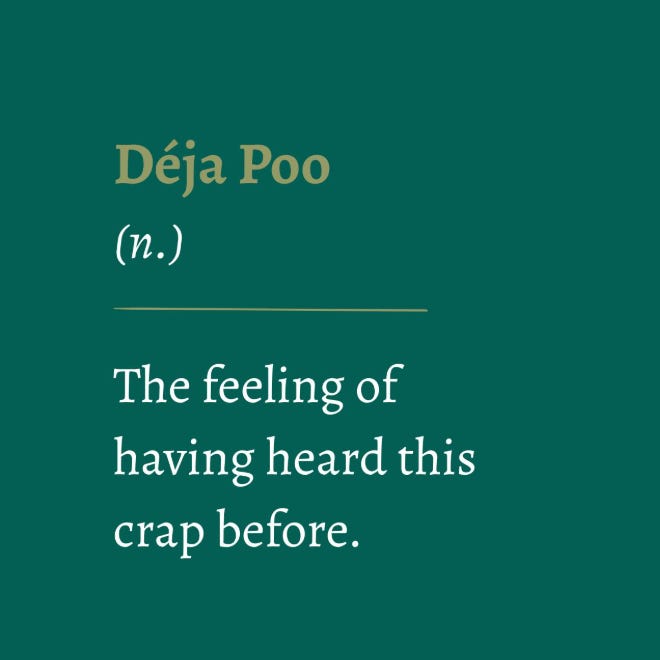
Meme of the week
Continuing a theme from last week…
Enjoyed this? Subscribe to receive more like this in your inbox each Friday. Or follow to ensure you see my posts in the Substack app. You can also read my full Substack archive here.
Want to read more from me? Read my book, Do Sweat the Small Stuff, or follow me on Linkedin for more regular content.
Please use this button to share this post with someone who you think would enjoy it!
Get in touch by email if you’d like to explore me speaking to your organisation or at your event, or are interested in working with me as a coach.
Thanks for reading. See you next week!
Sarah