
Just say why
The one sentence that prevents a dozen misunderstandings

“I need you to take this one.”
She was a senior consultant. Good at her job, and known for staying calm under pressure.
And she spent the entire weekend catastrophising.
Her manager had handed her a complex client project on Friday afternoon with six words and not much else. I need you to take this one. No context, no framing, and no indication of what this one actually meant.
Was it a test? Was the manager too stretched to run it properly? Was the client difficult and nobody wanted to say so? Was she being set up to fail – or handed something she wasn’t ready for?
She walked into Monday’s kick-off meeting tight and defensive. Her manager was baffled. The energy was off from the start, and neither of them could quite articulate why.
Later, with a subsequent project, the manager decided to try something different.
“I’m giving you this client because I trust your judgement and I want you to have experience at this level. My intention is to be available to support you, not to micromanage. Sound good?”
Same information, but a completely different experience for the recipient. The consultant asked clarifying questions, got stuck in, and delivered well.
One sentence was all it took. Let’s explore why many leaders don’t say it.

The gap nobody talks about
Here’s the thing about intentions: they feel obvious to the person who has them.
When a leader asks a pointed question, they know they’re curious. When they delegate a stretch project, they know it’s a vote of confidence. When they go quiet in a meeting, they know they’re thinking.
But the person on the receiving end? They have none of that context. What they have is a gap – and when we don’t fill it clearly, people fill it themselves.
In Do Sweat the Small Stuff, I describe this as the transparency trap: the tendency to assume understanding in others, to not take time to explain because it feels unnecessary, or because it will waste time. It’s a habit born of efficiency, but that efficiency is an illusion. You save thirty seconds of explanation and create three days of misunderstanding.
The gap isn’t neutral, because by nature, most people won’t fill it with the most generous interpretation. They fill it with the most familiar one – which, for most of us, means the most anxious one.
When silence does the talking
Think about how this plays out in practice:
Questions sound like interrogations.
Feedback sounds like criticism.
Delegation sounds like dumping.
Directiveness sounds like dismissal.
Silence sounds like disapproval.
None of that is what you meant, but it is hard for intention to travel without words.
There’s a reason this matters beyond individual relationships. Ambiguity generates anxiety, and anxiety closes down exactly the behaviours leaders need from their teams: honest conversation, creative thinking, appropriate risk-taking. You cannot build a psychologically safe environment on a foundation of unexplained actions.
And the human brain doesn’t help. Author and entrepreneur Isaac Lidsky articulates it well in his TED talk:
“Your fears distort your reality… Fear fills the void at all costs, passing off what you dread for what you know, offering up the worst in place of the ambiguous.”
In other words, when we don’t know, we don’t stay neutral: we awfulise. We take the unknown and replace it with the awful. Your team is doing this in every interaction where your intention isn’t clear – not because they’re catastrophists, but because that’s what human brains are wired to do when they don’t have enough information.
The irony is that the time you save by not explaining is the time your team spends decoding, worrying, and second-guessing. That’s not efficiency, it’s a deferred cost, and not a small one.
The shift is smaller than you think
This isn’t about softening your leadership or over-explaining every decision. It’s about removing unnecessary noise from the signal.
One sentence up front can change the entire dynamic of what follows.
“I’m asking because I’m curious, not because I think you’re wrong.”
“I’m giving you this because I trust you, not because I’m overwhelmed.”
“I’m quiet because I’m thinking, not because I’m angry.”
That’s it. The listener is no longer trying to decode what you really mean – they’re just listening.
In the book, I describe clarity of intention as one of the four foundational pillars of effective leadership. It’s not enough simply to have good intentions; they need to be visible. When intention and impact are aligned, trust builds. When they’re not – even when the intention was fine – the gap does the damage.
Stating your intention out loud is how you close that gap before it opens.
When it matters most
This isn’t required in every conversation. But there are moments when the stakes of ambiguity are high enough to make it non-negotiable.
When you’re giving feedback. Name your intention before the difficult message. “I’m raising this because I want to support your development” changes how someone receives what comes next.
When you’re delegating stretch work. Say why you chose them and what your involvement will look like. Don’t make them guess whether this is a reward or a burden.
When you’re asking questions about someone’s work. The difference between “Tell me about your approach” as curiosity versus scrutiny is invisible – unless you say which one it is.
When you’re being directive. If a decision isn’t up for debate, say so, and say why. People expend significant energy trying to influence decisions that have already been made. That’s a waste for everyone.
When you go quiet. Silence is rarely interpreted as neutral. A simple “I’m thinking, give me a moment” stops the room filling in the blank.
The timing also matters: front-load the intention, don’t offer it as a retrospective explanation when the damage is already done. Say it before you say the thing – not after you’ve noticed the energy shift.
What they hear when you don’t say why
Most leadership misunderstandings don’t come from what leaders say, they come from what leaders assume they don’t need to say.
It’s not that your team doesn’t trust you, it’s that they’re filling a gap that you left open, with the only material available – their own fears and assumptions.
The fix is genuinely small. Before your next feedback conversation, delegation, or pointed question, complete this sentence out loud: “My intention here is…”
Notice what changes, in the room, and in you.
Hit reply or leave a comment to share: what’s one conversation coming up this week where stating your intention upfront might change the dynamic – and what would you say?
Restack
An interesting read on the difference between focusing on process vs outcomes.

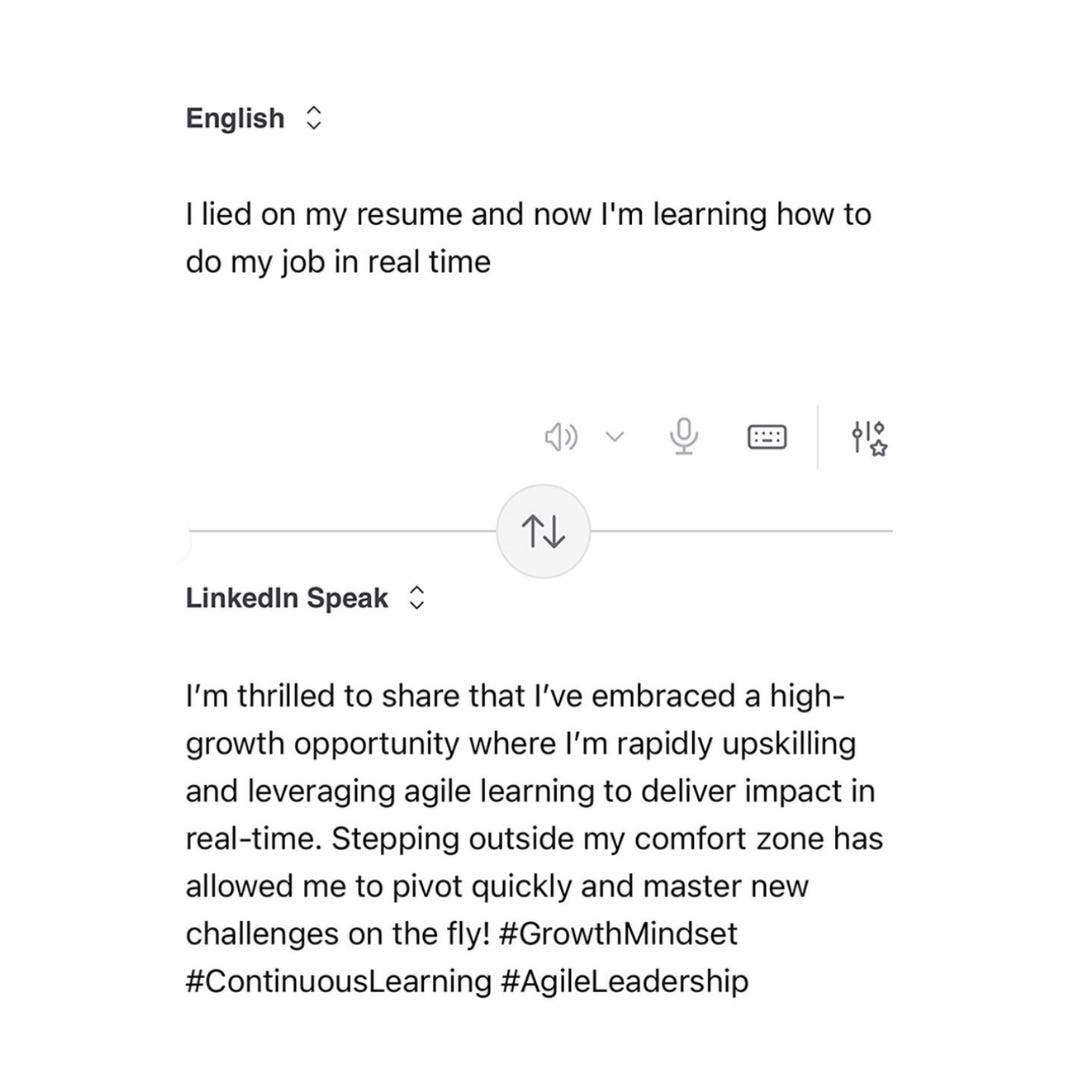
Meme of the week
Someone built a Google Translate tool for LinkedIn and it is 👌 The whole post is well worth a scroll through…
Want to read more from me? Read my book, Do Sweat the Small Stuff, or read my full Substack archive here. Follow me on Linkedin for more regular content.
Please use this button to share this with someone who you think would enjoy it!
Get in touch by email if you’d like to explore me speaking to your organisation or at your event, or are interested in working with me as a coach.
Thanks for reading. See you next week!