
Running on empty
What it costs your team when you won't stop

I’m writing this sitting in the departures area of Heathrow T5 at 5:45am. My gate isn’t open yet. I have a coffee, my coffee, my trusty London 2012 rucksack as carry-on, and a list of things I told myself I would finish before I left that I have demonstrably not done.
And yet, I am here.
For anyone who knows me, that is progress. For a long time after I started my own business, I wouldn’t have been. I’d have found a reason to delay, or I’d have gone but kept one foot – and both eyes – at work. This year, I made a commitment to myself to go anyway, things undone and all.
By the time you read this, I’ll be in Portugal, almost certainly eating my bodyweight in Pastéis de Nata and drinking port. Sorry not sorry.
But I’m writing this one for you as much as for me. Because if you’re anything like me, you’ll recognise the pattern I’m about to describe.

The finish line that moves
At some point, most of us absorbed a belief about rest: that we have to earn it. That downtime and relaxation is a reward for completed work, and that we get to stop when the work is done.
There’s a pretty obvious problem with that logic: the work is never done.
There will always be a project in progress, a deliverable due, a conversation that needs following up, or a piece of thinking that isn’t quite there yet. That is the nature of working at this level. But the inbox doesn’t reach zero (or at least never stays there). And the diary, left to its own devices, will fill back up within forty-eight hours of being cleared.
And so we wait. We push the holiday back by two weeks, we take the laptop, just in case (yes, I know, I brought mine, that’s where I’m writing this…). We tell ourselves we’ll properly switch off once this project is over, once things calm down.
But as we know, they don’t quieten down. The finish line moves, and so we don’t stop.
What it costs you – and everyone around you
Here’s what I know from working with senior leaders: depletion isn’t invisible. You cannot run on empty and expect it not to show.
When you are exhausted, your thinking suffers, your patience shortens and your presence in every conversation – every micro-interaction with your team – diminishes. You’re there, but you’re not really there. And the people around you feel it, even if no one says a word.
What we often forget is that emotions and energy are contagious. Your team subconsciously picks up on what you bring into the room – from your face, your tone, your energy – and they respond accordingly. A frazzled leader creates a frazzled team. Not through any single dramatic moment, but through the slow accumulation of small signals sent in dozens of interactions every day.
Refusing to rest is, in other words, not just a problem for you; it becomes a problem for everyone around you.
You’re also modelling to your team what is OK, and what isn’t. If you don’t take breaks, your team won’t feel they can either. Not because you’ve told them they can’t, but because you’ve shown them that rest isn’t really how things are done around here. You are always being watched, whether you intend it or not.
“But what if everything falls apart?”
There’s one more thing we need to address around this. The little belief that often underlies all of this: the fear that if you genuinely switch off, things will fall apart.
Maybe they will. It’s unlikely – but let’s say, for the sake of argument, they do.
If that’s true, it is not a reason to never take a holiday. It is quite frankly a serious and urgent problem with how your team or your organisation is set up. An operation that can only function if one person never takes a break is not a resilient operation; it is a single point of failure, dressed up as dedication.
The more honest version of this fear is that it is often less about the organisation and more about our own identity. We want to be needed, we want to matter. Taking a step back can feel uncomfortably like discovering we are more replaceable than we thought. And that isn’t something our ego likes to contemplate.
That discomfort is worth sitting with. Because a team that can hold things together while you’re away is not a threat to your leadership, it is evidence that your leadership is working.
“But I shouldn’t need time off”
Spending time on yourself can feel self-indulgent. I’d argue it is anything but, because the time you invest in yourself has a direct impact on everyone around you.
Rest is a requirement for sustained performance. Done right, it is an act of leadership in itself – a visible signal that recovery matters, that your team has permission to be human, that showing up well is more important than showing up constantly.
Here are a few things worth doing before you go:
Stop waiting for the work to be done. It won’t be. Book it anyway.
Brief your team properly. Clarity before you leave is the gift that means they don’t need to reach you.
Name someone to hold the fort. Not as a last resort – as a deliberate act of delegation.
Set the out-of-office and mean it (yes, yes, I’ll go and do this now…)
Accept that some things will be outstanding when you go. They were always going to be. They will still be there when you get back – or perhaps they won’t, as someone else will have handled them. Both outcomes are instructive.
And on switching off: the decision to not check in is its own small act of intentionality. Choose it, and choose it deliberately.
Before I go through the gate
As I close my laptop and head to the gate, some things remain unfinished, yet I’m pretty sure the world will continue to turn.
Here’s what I want to leave you with: the break you keep not taking isn’t optional.
The version of you that arrives back from it – restored, clear-headed, present – will show up differently in every single interaction. That matters more than whatever is sitting in your inbox right now.
Go. You need it. Even if you wish you didn’t.
Hit reply or leave a comment – what’s the thing you’re waiting to finish before you let yourself stop?
Restack
A lovely one this week from Adekunle Adekunbi with a reminder that some of us might need to (re) learn how to rest.

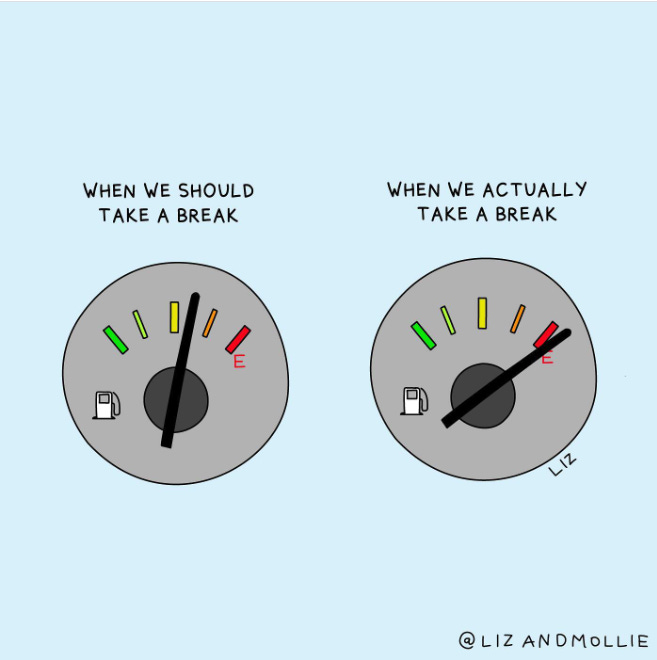
Meme of the week
As always, Liz and Mollie have it spot on.
Want to read more from me? Read my book, Do Sweat the Small Stuff, or read my full Substack archive here. Follow me on Linkedin for more regular content.
Please use this button to share this with someone who you think would enjoy it!
Get in touch by email if you’d like to explore me speaking to your organisation or at your event, or are interested in working with me as a coach.
Thanks for reading. See you next week!